
London Diary
PUREWAL TWINS MADE WEMBLEY CUP FINAL HISTORY

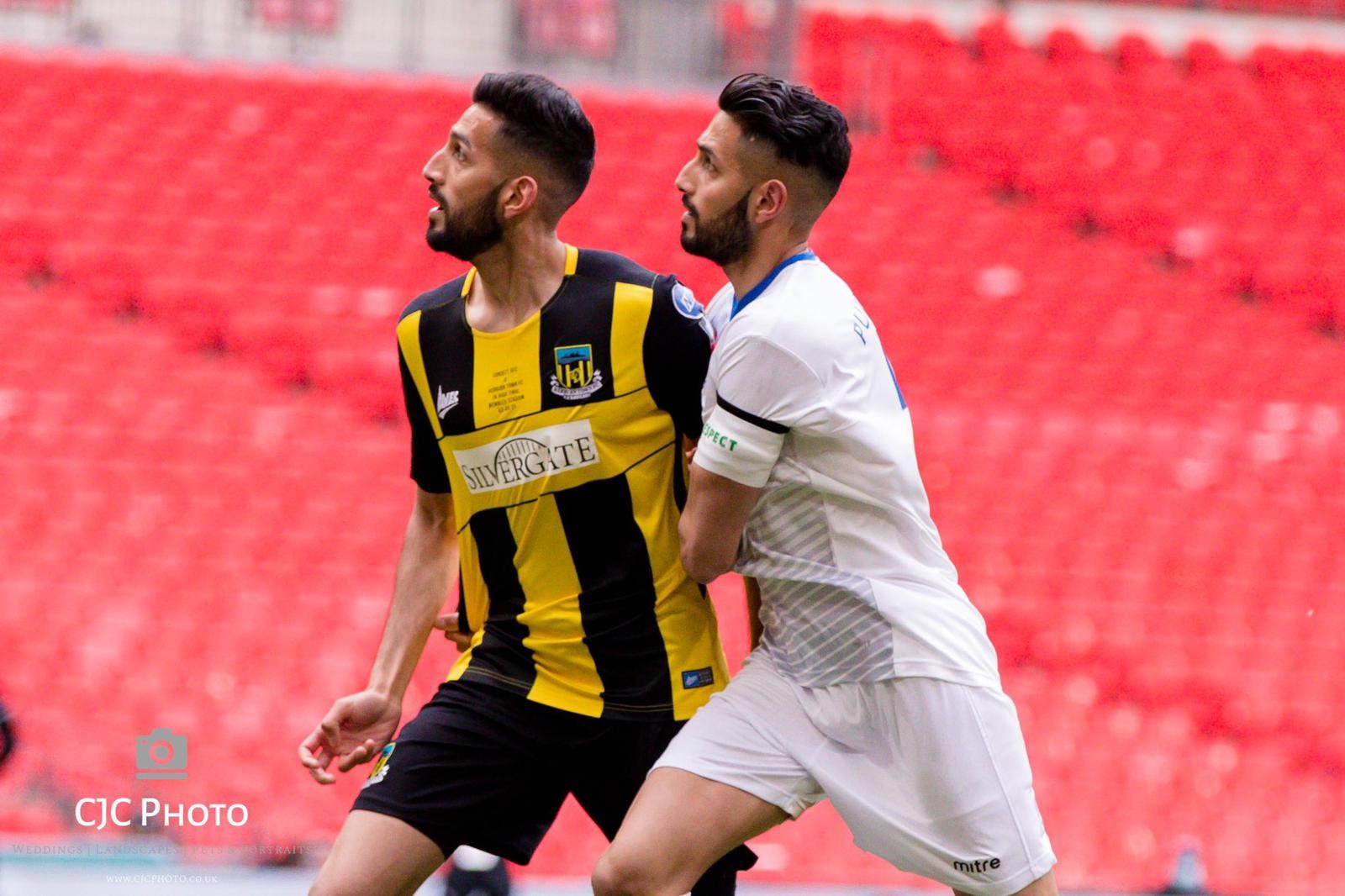
PUREWAL TWINS MADE WEMBLEY CUP FINAL HISTORY
AMAR AND ARJUN PUREWAL BECOME THE FIRST BRITISH SOUTH ASIANS TO FACE EACH OTHER AT WEMBLEY FOR NORTH-EAST RIVALS HEBBURN TOWN AND CONSETT
Thirty-one-year-old identical British South Asian Twins Amar and Arjun Purewal made history lining up against each other in May at Wembley Stadium in FA Vase final; Amar lead the line for Hebburn Town with Arjun as captain. Making them first pair of identical twins to play in a major final at Wembley, as well as being the first Asian players.
Amar and Arjun are well known in the region having played at the likes of Darlington, Bishop Auckland, Blyth Spartans, Whitby Town and Durham City between them.
Born and bought up in Sunderland and studied gaining their foundation degree in sports and fitness, both Amar and Arjun have showcased their entrepreneur skill’s by running their own football coaching academy in Sunderland, where you will see them coaching future talent with local schools.
2021 will see the twins going from strength to strength, Amar and Arjun will be announced as ambassadors for The Sikh Games in August 2021 followed by some major collaboration announcements.
The world will see the 2 talented twins represent the Asian community and raising awareness showing that Asians can make progress in football.
You made history in Wembley what did that feel like?
It felt absolutely amazing! One to step foot out at that amazing arena but two to be playing on BT Sport in a national cup final with my twin brother on the opposite side was unique and crazy. The week building up to the game was surreal with us having so many media duties such as BBC radio Newcastle, BBC look north, ITV Tyne tees etc but it really hit home when we both went live on sky sports news. A news station that is constantly on in our households and now we were on their live.
Being Sikh is something I’m proud of and to be representing that many people around not just the country but the world made me very honoured. I feel as though not just Sikhs, but a lot more south Asians would have watched the game as they would have two lads they could relate too.
The game itself was a fantastic spectacle for non-league football. It was played with great intensity and fight by both teams. To score at Wembley is every kids dream and mine was no different. The feeling of the ball hitting the back of the net will stay with me forever. Super proud day and will definitely go down as one of the best days of my life! At same point it was bitter sweet as one of had to win and one had to be on the losing team but none the less, was a brilliant day.
At what age did you start playing football?
We first started kicking a ball around at the age of 3 and would regularly play in the garden kicking ball to each other or kicking it off the wall. That progressed to playing around the ‘garages’ which was our little patch with two garages as goals. We’d play for hours on end, one of us would go in goal and the other would take shots and vice versa. Then we’d play with our mates, 3v3 and it would be competitive, but it would go on for hours. It wasn’t until we were playing for the school teams and winning every single game without losing that we decided to try out for a boys’ club called Plains Farm.
Why football and not any other sporting activity?
We both loved football and cricket from a young age. Our late father watched cricket constantly and absolutely loved watching India, his favourite player was Sachin Tendulkar and from that we followed in his footsteps having massive love for cricket. We also played it a lot and practiced in the house which would end up with a lot of broken furniture etc.
Our dads dream was for us to play cricket for India and we joined a local team called Ryhope from the age of 10. We played for Ryhope until we were 18 but left as our season would overlap with the football season. It was at this point, we felt we needed to make a conscious decision to play one sport and give our all for it. Football was picked and I think it was our taste of playing football in academies (Amar at Newcastle United & Arjun at Darlington) as youths that made us want to pursue football. By 17 we were playing men’s football and felt it would only benefit us by trying to be the best we can be without distractions from other sports.
How many years have you been playing football for?
I have been playing football for a team since I was 7. We joined plains farm and played for them until we where 11. In that time, we represented our schools, district and counties. At the age of 11, I joined Newcastle United and played for them for 5 years, this was the best experience as a youth as I was essentially in a professional environment, learning off the best coaches. After being released, I went to East Durham college and played there for 3 years. Whilst I played there, I also played for Ryhope CW under 18s but left after a season to play men’s football for firstly Newcastle Benfield when I was 16 and then joined Bishop Auckland for 2 years, It was at Bishop Auckland where me and my brother Arjun became the first set of twins to score in the same FA Cup tie in 2008. After leaving Bishop Auckland, we joined Durham City and this was a big step up. I finished top goal scorer in both seasons and got a move to Darlington on the back of it. Darlington was a great club with a massive fan base, We would regularly get 2,000 fans for a home game. I finished top goal scorer in 2 seasons before rupturing my anterior cruciate ligament which would keep me out for 14 months. A move to Shildon followed before joining West Auckland where I finished top goal scorer my 2nd season there before joining Hebburn town. At Hebburn town, we won the FA Vase at Wembley in my first season.
I have also competed for my country the Panjab FA in the 2016 CONIFA world cup in Russia. I finished top goal scorer with 7 goals in 5 games.
You run a coaching academy tell us more about it?
We studied at East Durham college and from there we went to Sunderland Uni to complete our degree in Sport and Fitness development. Part of the course was to do a business plan and for both of our business plans we did a sports coaching business and set it up as if we were running it.
Once we left uni, we both got job at sports coaching companies and branched out as AP Coaching in 2014 once we had achieved our coaching badges in certain sports and also had got experience in coaching.
We got contracts with schools and also set up our football camps in the school holidays. AP Coaching now has 10 schools and is running with 5 staff members. In schools we teach the children the pe curriculum, so it ranges from multiskills, to competitive games, to different sports etc. Its also working with children from different backgrounds etc but they are all primary school children.
What was the thought about setting up the academy?
The thought behind setting up the academy was that we didn’t make it as professional footballers so we wanted to do the next best thing and that was to coach and make children better than what they could be. Firstly, it started as us both wanting to coach football, but anyone can do that. So, we got our coaching badges in a number of sports such as: football, cricket, basketball, dodgeball, fencing, multiskills course etc. Then from that, we got into schools maybe doing 3 hours a week but gradually after a while that improved and got more and more hours. Eventually word gets out and then we got a lot more schools and hours. We felt we could be our own bosses and put it into reality by working hard and getting our qualifications. We also wanted to give back to the community as we are from Sunderland and we feel that you should never forget your routes.
What are your proudest achievements?
My proudest achievements are: playing for Newcastle United for 5 years, breaking the FA Cup record by being the first set of twins to score in the same FA Cup tie, representing the districts, counites in football, by finishing top goal scorer for Durham City for 2 seasons in a row, joining Darlington and finishing top goal scorer in the first 2 seasons, representing my country Panjab FA in the 2016 CONIFA world cup and also being top goal scorer in the world cup, playing for Hebburn at Wembley, winning the FA Vase and scoring at Wembley.
Also recovering from a cruciate ligament injury after being out for 14 months which was very difficult as I missed playing football for a very long time but with a great family, they helped me mentally to overcome this big injury.
How do you manage bad behaviour?
When dealing with bad behaviour it can be different depending on what the behaviours are. For example, in the past when suffering racism, my first thought was always to get angry about the situation and be confrontational about it. Since I have grew up now and understand more about racism and how other people’s upbringings may have had a hand in them being racist, then I’d now be less confrontational and more trying to understand that person and why they have racist behaviours in their lives.
On the sporting field, dealing with emotions before a game is what makes or breaks a player in my opinion and how they perform. Before a game, I like to relax, chill out and not really get involved in distractions. I’ll be reserved in my behaviours, almost laid back and feel this helps with controlling emotions. Having played for years, I feel this is my best coping mechanism for a big game or any game in general.
Dealing with people with negative vibes is something I have just noticed more recently after I read the book ‘good vibes, good life’ by Vex king. It was a brilliant read and made me think a lot more about the people I want to associate with and how being in the same vibrational state is important. Being positive I feel is great and important, but you only feel that way if the people around you are on the same wavelength. If not then you find it like a vicious cycle that you can never get out of. After reading that book, I found that I only want to have people in my inner circle who are positive just like myself and if they are not then I’d keep my distance.
What is your best management tool?
My best management tool is AP Coaching which is our sports coaching business. It keeps me very busy and the aims of the business is too simply improving children’s ability from reception all the way through to year 6 and make them the best they can possibly be at sport and as human beings. We do this by making our PE lessons fun but also challenging and by doing this, it creates a buzz in the child’s mind of that they can always improve and that was how we were brought up ourselves. Working hand in hand with my brother is also great as we have the same drive and tenacity which is great. I’m currently based in one school and I’m in there fulltime. When I first went into the school, the aim was to get the school out of requires improvement and into a good position. After having Ofsted come into the school in my 2nd year, the school got a ‘good’ by them and also the PE was mentioned in the report as something the school should be proud of. This gave me great satisfaction. We have 10 schools and 5 staff. It can be very hectic at times, but the staff are fantastic and have a good drive to succeed which only makes us proud as a business.
The football camps which we run in the holidays are a success ad something that has taken time to build up. Back 5 years back, we would get 10 children and be happy. Nowadays we want 70-100 to keep us satisfied. We only have one camp running and feel that, as a business we need to branch out to different cities, or even different areas of Sunderland to get more and more children off the streets and playing football. We feel this is achievable after what we have both accomplished at Wembley back in June and something we are looking forward to doing in the future.
Who is the most underrated player you have played with/against?
The most underrated player I have played with and against is my brother Arjun. I say this as he is a very good leader and has captained of a lot of teams we have played on and against for years. He is very accomplished on the ball and is always positionally in a good place which is very important for a defender. He is as brave as a lion and will put his head in where it hurts and also will chip in with a fair few goals for a defender which is always handy. Very rarely does my brother get beaten 1v1 when defending which is a very good trait also. Finally. he has a winning mentality and cares about how he plays which I think is very important as it shows his commitment, dedication and sacrifice to the game.
What can you do on the pitch when you feel you aren’t in good form?
Going through dips of form is certainly normal for non- league players. One game you may be fantastic and the next you may feel miles away from where you were before. That’s part and parcel of football and dealing with inconsistencies can make you stronger mentally.
One thing I find that I try most when out of form is trying to work as hard as I possibly can. This is important as the harder you try; the more success you get I feel and things fall for you that perhaps didn’t when you where out of form. So, work rate is important; closing down the defenders, being brave and getting on the ball when maybe you’re not playing so well is also important and shows mental strength as some people may hide and don’t want the ball as they could be making mistakes. All these things for me, culminate to help you et out of a tough/sticky patch. The biggest thing for me though, is scoring goals. Once I do that, I never lose confidence.
What drives you to get up and go training every day?
With us being non-league players, we train 2 times a week plus a game on a Saturday. In between all that though, we’ll keep ticking over with gym work in our own time. Doing this is hugely important as I feel you have got to look after yourself properly to compete every training session and every game.
What drives me is being the best I can be no matter what I do. If I do something, I do it with 100% and nothing less. The gym work I feel is a big sacrifice as when I work full time, sometimes I really don’t want to work out, but that willingness to keep working hard doesn’t let me miss sessions.
What is your training schedule like? Do you practice every day?
My training schedule is training on a Tuesday and Thursday evening with a game on a Saturday afternoon. I like to go to the gym or do some form of exercise on a Monday and also a Wednesday as I feel it is important and beneficial. On a Friday evening I will relax as I have a game the following day. On a Sunday I will tend to switch off, but also if I’m really tired after my game, I may use my exercise bike for 2 minutes to get rid of the lactic acid from my legs.
It can be tough having a full-time job, having a family and playing football but it is what you do for something you really enjoy and have passion for.
Who is the sports icon that has influenced you the most?
I’m a very sporty person and don’t choose just one sport who I have icons from. In football Thierry Henry was an icon who I loved watching and taking bits of his game onto the pitch. He revolutionised how a striker would play on a football pitch which I took an interest to as I play in that position when I play football too. I loved how quick he was and direct, but also his winning mentality was evident to see when he played. The part I loved the most though, was the way he used to put the ball in the corner of the goal with his instep.
Floyd Mayweather is also a sporting icon I loved watching as I found his drive, willingness to succeed, determination, risks he took, his skills but most importantly how hard he trained. Watching loads of YouTube footage of him training was something I think I take now and wanting to improve on the training pitch every time I step foot out there.
Do you have a favourite team uniform?
I have one particular football top which is my favourite and that is Coventry City’s home strip last year. It was a lovely sky-blue shirt which is great as I love the colour sky blue and as a Coventry supporter who doesn’t see many years of success for the club, to see them wear that strip and perform so well last season always keeps a good memory.
Do you have a special routine or superstition before you play a big game?
This is dependent on how I have performed. So, if for example, I score a hat trick, then the following Saturday I will try and repeat what I did the game before. I do this as I feel I can’t complain as I prepared exactly the same way as the week before. One superstition I definitely always have though is putting my right boot on first. It just feels unnatural if I put my other one on first.
What do you do in your off time?
In my off time, I like to go to the gym and keep ticking over. I also spend time with my wife and daughter. With my daughter being still young (age 2), she’s so active and it’s the best time to spend watching her grow and learn is such an amazing thing. I like to spend time with friends and family also going out for meals at nice restaurants and just hanging out etc. If there is football or cricket on the tv I may watch that if I have the tv on also.
You both have children, would you encourage them to play football as a profession?
I would encourage my daughter to do anything she wanted to do. If one day she said she wanted me to teach her how to play football id be more than happy to. It’s something I have learnt from my mother who when I was younger said for us to follow our dreams and do something we enjoy, so the same would apply to Zara, whatever she wants to do, id be more than happy helping her to achieve it. Right now, football isn’t really something she likes, but as she grows up, she’ll see more of it as at AP Coaching (our business) we teach football so it may be something she gets into.
Where do you see yourself in ten years?

File picture of AMAR AND ARJUN PUREWAL






-

 London Diary5 years ago
Famous Red Light Area in London you must know? Read story here
-

 Bollywood5 years ago
Veteran Indian Music Director Anandji’s daughter Rita Shah Valambia passes away in London; Hello london and Hello Mumbai Co-Founder Kamal Prabhakar express grief
-

 All4 years ago
Everything you need to know : Proposed ULEZ expansion for 2023 With Strange exceptional zones on M4, M1, M11 A2, A20, A22, A13, A127, A12
-

 All4 years ago
10 Top Indian Bollywood Films Shot in London & UK
-

 All4 years ago
Change and Challenges: In the year 2023, What it means to London’s Famous red-light district Soho,
-

 All4 years ago
26-Year Combined Sentence for British-Palestinian People Smuggling Ring Led by Firdos Ahmed and Zarina Abdulla Handed Down by Chelmsford Crown Court
-

 All5 years ago
FAMOUS GURUDWARA OF LONDON
-

 Asian Community5 years ago
Meet Dr. Anu Chawla UK based IVF Specialist, she shares her Professional Journey on International Women’s Day